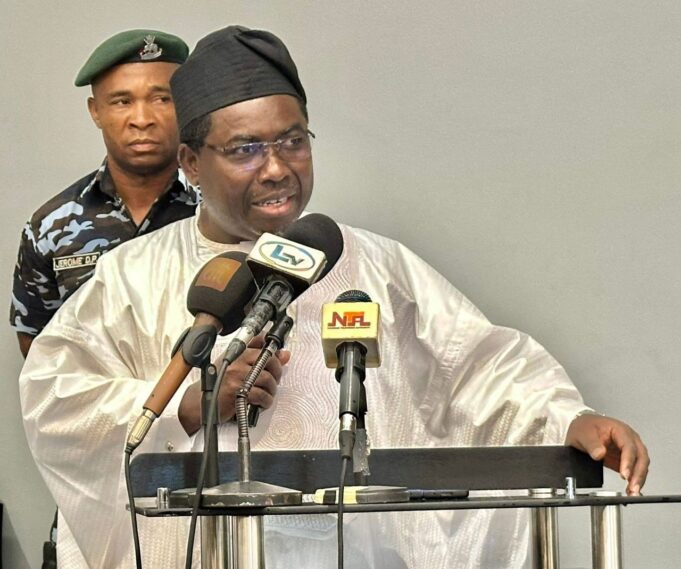
- INEC to conduct nationwide stress test of e-transmission system
- BVAS not nationally tested before 2023 poll, says Amupitan
- Commission assures 2023 glitch fixed ahead of 2027
- Abbas: Exclusive e-transmission may disenfranchise 40% voters
- Speaker cites poor internet access, power challenges
- Civil society faults Electoral Act 2026, seeks amendments
- ADC rejects April 2 deadline, launches free digital registration
The Independent National Electoral Commission (INEC) has unveiled plans to conduct a nationwide mock presidential election to test the reliability of its electronic results transmission system ahead of the 2027 general elections.
INEC Chairman, Prof Joash Amupitan, disclosed this yesterday in Abuja at the Citizens’ Townhall Meeting on Electoral Act 2026, organised by the Civil Society Network on Election Integrity.
He explained that the Bimodal Voter Accreditation System did not perform optimally during the 2023 presidential election because it was not tested on a national scale.
According to Amupitan, the proposed mock poll would simulate real election-day conditions across the country to assess the strength, speed and transparency of the commission’s electronic transmission architecture. He said the exercise would involve selected polling units nationwide and enable the commission to identify and address technical gaps before the next general elections.
He added that lessons learnt from the 2023 elections underscored the need for rigorous stress-testing of technological innovations, noting that public confidence in the electoral process depends largely on the credibility and efficiency of its systems.
The INEC chairman assured stakeholders that the commission remained committed to continuous improvement, transparency and collaboration with civil society groups to ensure a more seamless and credible electoral process in 2027 and beyond.
“So one of the things we are trying to do before the election, we’re going to have a mock presidential election so that we are sure that this transmission across the states must not fail,” he said.
Amupitan described the strengthened framework for electronic transmission of results as one of the most consequential provisions of the Electoral Act 2026. He disclosed that the commission pushed for transmission to be made mandatory during legislative consultations.
However, he cautioned against simplistic expectations about “real-time” transmission, citing logistical and network challenges experienced even within the Federal Capital Territory.
He assured that the glitch that marred the 2023 election had been eliminated and would not recur in 2027.
Recounting the recent FCT Area Council elections, he narrated how results from Kabir Ward in Kuje Area Council were delayed due to poor terrain and network inaccessibility, despite the ward being only a few hours from central Abuja.
“When our officials entered the area, we couldn’t reach them by phone. We had to physically confirm their safety before the results were eventually collated the next day,” he said.
He likened electronic transmission to mobile banking transfers. “You may send N50,000 instantly, and it leaves your account immediately, but the recipient may not receive the alert until later. That is the distinction between transmission and real-time confirmation,” he said.
In his intervention, a former Director in charge of Voter Education at INEC, Oluwole Osaze-Uzzi, argued that the Electoral Act 2026 represents a regression in Nigeria’s democratic journey.
He maintained that rather than consolidating gains recorded in previous reforms, certain provisions of the new law appeared to weaken critical safeguards designed to enhance transparency, accountability and public trust in the electoral process.
According to him, electoral legislation should progressively strengthen institutions and close loopholes exposed during past elections, not reopen them or introduce ambiguities that could undermine credibility.
“The law has taken us back. What it has given with the right hand, it has taken with the left hand,” he said.
Speaking on behalf of the coalition, the Executive Director of Yiaga Africa, Samson Itodo, called for immediate amendment of sections of the Act that create loopholes and ambiguities capable of enabling election manipulation. He also urged INEC to issue clear guidelines on the exercise.
Also, former Country Director of ActionAid Nigeria, Ene Obi, warned that rising campaign expenditure would effectively exclude ordinary citizens and grassroots candidates from participating in the political process.
Exclusive e-transmission will disenfranchise 40% voters, Abbas warns
The Speaker of the House of Representatives, Tajudeen Abbas, said the National Assembly approved a hybrid system of electronic and manual transmission of election results in the amended Electoral Act to prevent voter disenfranchisement and reduce apathy ahead of the 2027 general elections.
Abbas said Nigeria’s limited internet penetration and unstable power supply made it impractical to rely solely on real-time electronic transmission across the country.
He spoke while receiving the Ambassador of Spain to Nigeria, Felix Costales, during a courtesy visit to his office at the National Assembly complex in Abuja.
According to a statement issued by his Special Adviser on Media and Publicity, Musa Krishi, the Speaker received the envoy alongside the Chairman, House Committee on Appropriations, Abubakar Bichi; Chairman, House Committee on Foreign Affairs, Wole Oke; and Chairman, Nigeria-China Parliamentary Friendship Group, Jafaru Yakubu.
The statement noted that the Spanish envoy indicated that Spain also operates a system that allows manual transmission of election results.
Abbas assured that, based on his engagement with the leadership of the Independent National Electoral Commission, the 2027 general elections would be more credible and inclusive.
On the Electoral Act, the Speaker said some reactions to the amendment had gone “far beyond the exact level of the issue”, noting that while many advocate real-time electronic transmission, internet access in Nigeria remains inconsistent, even in cities such as Abuja.
He cited a report by the Nigerian Communications Commission, which he said indicated that about 40 per cent of the country remains underserved by internet coverage. He added that voter turnout has remained low, with only about 12–15 per cent of registered voters participating in elections, describing it as voter apathy.
According to him, adopting an exclusively electronic system could further suppress participation, as areas without adequate internet access may be unable to transmit results electronically, potentially leading to disenfranchisement and lower turnout.
He said the National Assembly, in its judgement, opted for a hybrid approach, allowing electronic transmission where feasible and manual transmission where necessary, stressing that a single method could not be effectively applied across all parts of the country at this stage.
Abbas also pointed to infrastructural challenges, including inadequate electricity supply, noting that internet services depend on stable power. He questioned how nationwide real-time transmission could be sustained on election day without reliable energy.
Describing democracy as a gradual process, the Speaker said Nigeria would continue to improve “year after year, election after election”, and expressed optimism that collaboration with countries such as Spain would strengthen legislative competence, particularly in areas such as legislative drafting.
He added that while Nigeria still faces challenges, the country was making steady progress and continuing to learn and improve.
Earlier, Costales said his visit was aimed at strengthening legislative diplomacy and deepening bilateral ties between Spain and Nigeria. He said Spain would monitor Nigeria’s electoral process and support efforts to strengthen democratic institutions.
He acknowledged that political polarisation was a global phenomenon and stressed the importance of compromise and consensus in democratic governance.
ADC begins free online membership registration nationwide
The African Democratic Congress (ADC) has announced the commencement of free online membership registration nationwide.
The party said the initiative was intended to build on the momentum of its membership registration and revalidation exercise launched last month.
Earlier on Friday, February 27, 2026, while rejecting the Independent National Electoral Commission’s timetable for the general election and Section 77(4) of the Electoral Act 2026, the party lamented that political parties are required to submit their digital membership registers not later than April 2, 2026.
It said the timeline effectively creates barriers for opposition participation, stating: “That is only 34 days away.
“Section 77(7) further provides that any party that fails to submit its membership register within the stipulated time shall not be eligible to field a candidate for that election.
“These are not housekeeping rules. They are deliberately constructed barriers to exclude opposition from partaking in the coming election.”
However, in a statement yesterday, the party’s National Publicity Secretary, Bolaji Abdullahi, officially announced the commencement of free online membership registration across Nigeria. He said the exercise followed the successful kick-off of the party’s nationwide registration and revalidation in Abuja last month.
“The new digital registration platform is designed to enable the party to meet the requirements of the new Electoral Act 2026, regarding the digital membership register.
“Accordingly, only individuals whose membership details are fully captured and verified in the Party’s official digital register will be eligible to vote or be voted for in the Party’s primaries.
“Since the launch of the physical and grassroots membership exercise in February, we have recorded strong interest from Nigerians across states and the diaspora.
“Apart from meeting legal requirements, the introduction of the free online option is designed to remove barriers to entry, simplify enrolment, and ensure that every eligible Nigerian who wishes to identify with the ADC can do so seamlessly and securely.
“Members who have registered on the Party’s previous platform are also required to revalidate their membership on the new digital portal, as additional mandatory information is now required to ensure full compliance with the Electoral Act and INEC guidelines.”
The Guardian