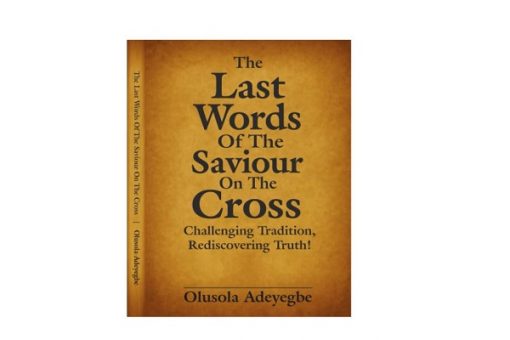
Title: The Last Words of the Saviour on the Cross
Author: Olusola Adeyegbe
Publisher: Cowrie Mindworks Limited
Reviewer: Raymond Mordi
Pagination: 82
Olusola Adeyegbe’s The Last Words of the Saviour on the Cross enters today’s often polarised religious landscape with the quiet assurance of a thinker who has wrestled deeply with faith, doctrine, and the fundamental question at the heart of Christianity: What was the purpose of Christ’s coming?
Drawing inspiration from the work, In the Light of Truth: The Grail Message by Abd-ru-shin, Adeyegbe offers neither a theological polemic nor a sentimental devotional. Instead, he presents a reflective and provocatively gentle meditation that encourages readers to reconsider long‑held assumptions about the crucifixion, redemption, and the true mission of Jesus of Nazareth.
The result is a work that both challenges and enriches—one that may unsettle traditionalists yet offer refreshing clarity to readers seeking a coherent, spiritually grounded understanding of Christ’s message.
Across its nine chapters, the book advances a striking but straightforward claim: Christ’s mission is centred not on His death but on His teaching: His revelation of the Divine Truth. Christ’s crucifixion, Adeyegbe argues, represents humanity’s tragic rejection of that Truth, not a divinely mandated path to redemption.
This framing aligns with the Grail Message’s distinction between the Cross of Suffering—the instrument of execution at Golgotha—and the Cross of Redemption, the radiant, equal‑armed Cross symbolising the Eternal Truth.
Redemption, in this view, does not come from Christ absorbing human guilt or fulfilling a metaphysical transaction. Instead, it arises only when individuals awaken to the Truth He brought and live in obedience to it.
This interpretation of the mission of the Son of God distances the book from Anselm’s satisfaction theory, the Reformers’ penal substitution, and the patristic “ransom” motifs—traditions the author explores as historically shaped constructs rather than divine revelation.
Yet Adeyegbe’s critique of these doctrines is without hostility. With calm precision, he traces their evolution. He invites readers to consider whether, over the centuries, theology has drifted from the simplicity of Christ’s call to repentance, obedience, and spiritual renewal.
One of the book’s strengths is Adeyegbe’s contemplative use of the Scripture. Instead of argument-driven citations, he treats biblical passages as reflective windows that invite inward thought. Throughout the chapters and the extensive Appendix, he builds a steady, cumulative case:
If Christ’s death were divinely required, why is Judas’ betrayal portrayed as sin rather than obedience? Why would Pilate’s wife receive a warning in a dream? Why would Jesus label His executioners as acting in ignorance? Why would the Commandment “Thou shalt not kill” remain unbroken and uncompromised?
Why would Christ lament that His word had “no place” in His opponents?
Taken together, these scenes reinforce a consistent theme: the crucifixion was law‑breaking, not law‑fulfilling; rejection, not redemption; human blindness, not divine necessity.
The power of the book lies not in dramatic rhetoric but in its meditative pace, inviting readers into a quiet, contemplative engagement with theology.
Chapter Nine, arguably the book’s most compelling section, distils Christ’s mission into seven themes: rejection, ignored warnings, the conflict between divine law and human sin, obedience to Truth, repentance, cleansing through the Word, and the symbolism of ‘washed robes’. This focus sharpens understanding of the central message and invites deeper reflection.
Here, Adeyegbe becomes pastoral. He does not dictate doctrine; he invites reflection. For readers familiar with the Grail Message, the focus on personal responsibility and spiritual volition will feel familiar. For newcomers, this chapter may serve as a surprising, fresh doorway into the teachings of Christ.
The 15 reflections of Appendix 1 feel like a companion volume embedded within the main section of the book. Each reflection revisits a familiar scriptural scene—Herod’s rage, Judas’ betrayal, Pilate’s hesitation, the transfiguration, the prodigal son—and draws a moral or spiritual insight consistent with the book’s central argument: salvation begins with awakening, grows through obedience, and manifests in transformed conduct.
This Appendix alone could function as a devotional guide for readers seeking depth without dogmatic rigidity.
Beneath the biblical analysis lies a subtle but powerful critique of traditional doctrines. Adeyegbe echoes themes of the Grail Message in warning against an intellect disconnected from spiritual intuition. Lucifer’s influence, he suggests, manifests not in dramatic rebellion but in humanity’s quiet elevation of the intellect above the spirit, prompting readers to reconsider long-held beliefs.
Elevating the intellect above the spirit feels remarkably relevant in an age marked by both scepticism and longing. The call to reawaken intuition—and reject the “sloth of avoiding true spiritual responsibility”—is timely and resonant.
Stylistically, the prose bridges theological reflection and spiritual literature. Warm, steady, and contemplative, Adeyegbe’s voice is both grounded and mystical. Study questions at the end widen the book’s usefulness, making it suitable for personal retreats, small groups, or church circles willing to entertain fresh perspectives.
Adeyegbe’s background as a lawyer, teacher, and long‑time student of the Grail Message enriches the work with intellectual rigour and spiritual sincerity.
His earlier writings—Make Your Work a Prayer, The R.E.A.L. Shift, Living Your Best Life, and Think a little Premium—demonstrate a consistent commitment to inner transformation.
In an African context, the book’s willingness to question inherited doctrines while maintaining deep reverence for Christ encourages readers to explore faith with courage and nuance.
Many readers steeped in traditional theology may struggle with the book’s departure from familiar doctrinal frameworks. Yet even those who disagree will likely appreciate the sincerity, clarity, and contemplative depth of Adeyegbe’s approach.
The Last Words of the Saviour on the Cross is a courageous and contemplative contribution to contemporary spiritual discourse. It challenges assumptions without undermining faith and reframes the crucifixion not as a cosmic transaction but as a mirror held up to the human soul.
It is a book for thinkers, seekers, and any reader longing to encounter Christ’s mission through a fresh yet reverent lens.
In the end, Adeyegbe’s message is simple and stirring: salvation depends on personal choice: living according to the Truth, embracing love, and aligning with God’s Will.
A timely, thoughtful, and transformative work.
The Nation